
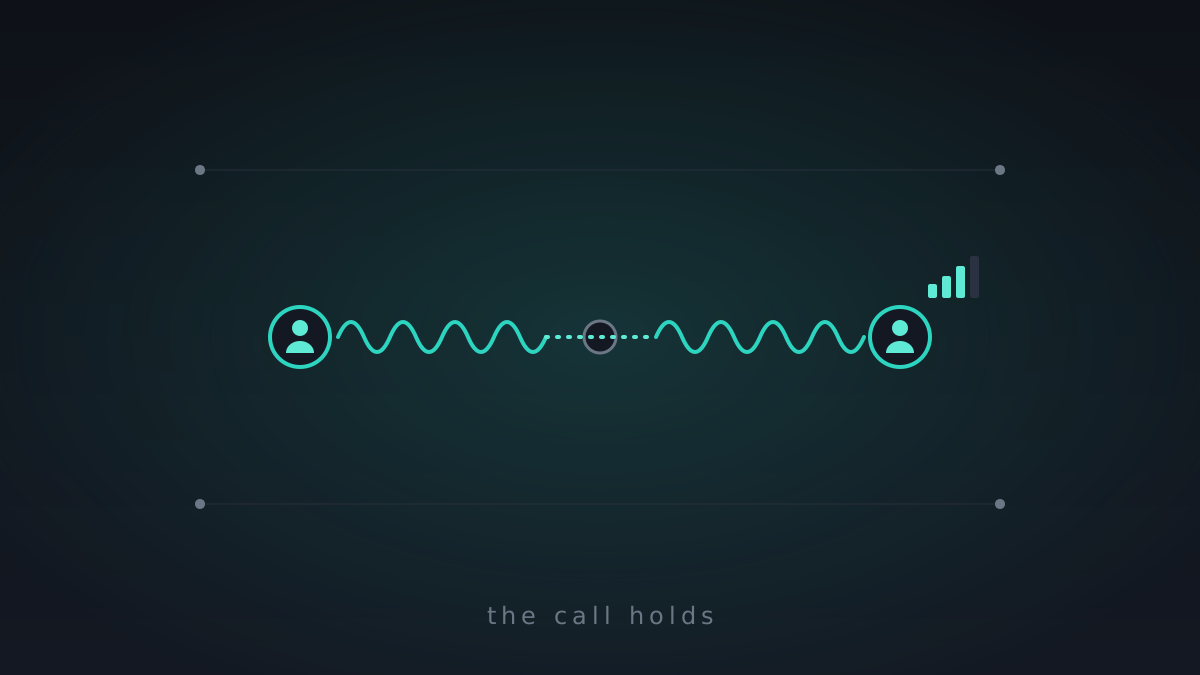
Last week I said the big new surface was probably done and the job now was making it all solid. This week was exactly that — with two things that happen to be new anyway: calls that hold up on a bad network, and an AI agent that can work with your documents, on your terms.
Calls that survive a bad link
Real-time audio and video over a peer-to-peer mesh — often relayed through another node, often on someone's flaky Wi-Fi — is genuinely hard, and calls have been the most fragile thing in MeshHold. So they got rebuilt.
Audio and video now travel as datagrams, even across a relay, so one lost packet doesn't stall the whole stream waiting for a retransmit that no longer matters. A jitter buffer primes before it starts playing, sizes itself to the link, and can tell a frame that's merely late from one that's genuinely lost — concealing the gap with the voice rather than a click of silence. Quality climbs and backs off based on what the path can actually carry, not on what the camera happened to produce: a slow link gets a small picture instead of no picture, and drops to voice-only before it drops the call. And when something's wrong, the call panel now says what — instead of a blank readout and a shrug.
It's the least glamorous kind of work and the most necessary: taking the feature that already existed and making it stop falling over.
An agent that can read your files — if you let it
The other new thing: you can now let an AI agent work with the documents in a vault. It can search a vault, read a file, even edit a document — but the whole design is built around you holding the leash. Each agent instance declares exactly which vaults it may touch; a conversation that has read your files has to ask before it acts on them; and an edit comes back as a suggestion you accept or reject, never a silent overwrite. An agent's results can be plain attachments now, too — a generated image or file you open like anything else.
The goal was an assistant that can genuinely help with your own stuff — "find the invoice from March," "tighten up this draft" — without it being a machine you've handed the keys to. Scoped, consented, reversible.
The office filled in the corners
The office suite spent the week finishing its long tail. The word processor picked up the features that separate a text box from a document you'd actually file: endnotes, bookmarks, a watermark, text frames, real equations (MathML, not a picture of one), shapes, multi-column layouts, landscape pages, and the document's own properties. The spreadsheet got the grown-up tools — pivot tables, named ranges, array formulas, references to another file, remove-duplicates and text-to-columns. Dull to list; it's the difference between a demo and something you'd trust with real work.
Under the hood
A few quieter ones worth naming. Storage grew roles: a node can be a keyless holder — it stores encrypted blocks it can't itself read — and how many copies a file keeps is a property of the vault, not a negotiation with each node. A block cache now keeps things you fetched but don't permanently hold, so a re-read doesn't cross the network twice. The model catalog got a generation newer (Gemma-class weights, Apache-licensed) with a calculator that tells you honestly which models fit your graphics card. And the boot animation got cut to a punchier six seconds, still drawn from your actual mesh.
None of it is a billboard feature. All of it is what the last stretch before 0.8 is made of: taking the things that were rough and making them hold.
Since last week
- Calls rebuilt: audio and video ride datagrams even across a relay, so a lost packet doesn't stall the stream; a self-sizing jitter buffer that conceals loss with the voice; adaptive quality that climbs and backs off on what the link can carry (a small picture, then voice-only, before dropping the call); and a call panel that says what's actually wrong
- An agent for your documents: let an agent search a vault and read or edit files — scoped to the vaults you name, asking before it acts, and returning edits as suggestions rather than overwrites; agent results can be opened as ordinary attachments
- Office long tail: the word processor gains endnotes, bookmarks, a watermark, text frames, MathML equations, shapes, multi-column and landscape layouts, and document properties; the spreadsheet gains pivot tables, named ranges, array formulas, cross-file references, remove-duplicates and text-to-columns
- Storage roles: a node can be a keyless holder that stores blocks it can't read; the replication factor belongs to the vault, not to each node; plus a block cache for data fetched but not held
- A fresher model catalog: newer, Apache-licensed weights and a calculator that says which models actually fit your card, with the arithmetic shown
- A tighter boot film: the startup animation trimmed to six seconds, still rendered from your real mesh topology